HISTORICAL CURIOSITIES

In this section you will find a series of curiosities and historical news that can be the inspiration for some pleasant reading.
WHO WAS MESULLAM

Mesullam, in Semitic languages, means “friendship.” It is the name borne by several biblical figures.
It is also the name of a skilled archer who was part of Xenophon’s expedition of the Ten Thousand, whose story is told in the Anabasis. When the leaders of the expedition were uncertain about which direction to take, they consulted the haruspices, who tried to interpret the flight of birds. Mesullam then shot an arrow and brought down one of these birds, explaining that one could hardly rely on animals incapable of foreseeing their own imminent death, and that therefore any decision based on their flight could not be considered trustworthy.Mesullam was thus a courteous forerunner of rational thought over superstitious belief.
LET ME INTRODUCE YOU TO LEMANJA

MENELAUS WAS BLOND
You might wonder what Menelaus has to do with the ancient East.
He is connected because Homer wrote in Ionia, a small coastal region of Asia Minor, which was also home to the first pre-Socratic philosophers.
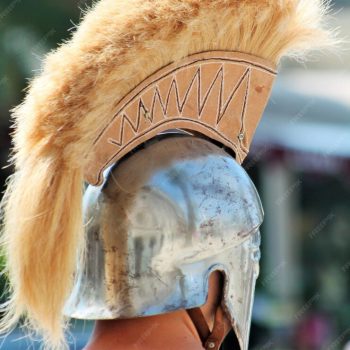
In the Iliad, there are 21 mentions of blond characters: Menelaus was blond—he is always described as “blond Menelaus”; but so were Achilles, Meleager, and Demeter, and even Nestor’s 150 mares were blond. Agamede, daughter of Augeas, king of Elis (who did not take part in the war), is also described as blond.
In the Odyssey (XIII, 397 ff.), Athena disguises Odysseus before he confronts the suitors and “makes his blond hair disappear.”
Athena herself, in the famous statue by Phidias in Athens, was depicted with golden hair and ivory skin—in the so-called chryselephantine (χρῡσελεφάντινος, chrȳselephántinos) technique.
This contrasts with how we perceive modern Greeks, who typically have dark hair. It is not impossible, however, that things were different in ancient times.
The origins of the Hellenes, or Greeks, are rather complex and varied: starting with the Minoans (the brilliant Cretan civilization, c. 2500–1600 BCE), then probably the arrival of the Achaeans, followed by the Danuna—nearly contemporaneous with the Mycenaeans—and later the Ionians and Aeolians. Homer, however, mentions only the Achaeans and Danaans, who may correspond to the Aḫḫiyawa and the Danuna, the latter being among the Sea Peoples, who are thought to have played a role in the collapse of the Eastern Mediterranean world toward the end of the Bronze Age (around 1200 BCE).
But that is another story
altogether.
© 2025 Federico Carra. All rights reserved to the author..
